
This Origin Story was written by Vera Campbell – February, 2025
The Sun shone brightly upon the earth, delighted to have gotten its light back from troublesome Raven. Clouds formed, rains fell, and rivers flowed from mountains to the sea. And trees grew, from which Man made boats. And, of course, paddles. Eons of time passed. Raven cawed.
The sun was shining upon Brad Snow and a group of Fairbanksans gathered at the College & University gas station. Their cars were topped with canoes when Brad spotted a Toyota Four Runner emerging from Farmers Loop onto University Avenue, also topped with a canoe. Not just any canoe, a whitewater canoe. Not just any whitewater canoe, a Whitesell. They stared.
Before Brad and his friends could jump in their car and chase it down, the canoe made a U-turn on University Ave, in busy traffic, and swung into the gas station. The ravens laughed, gliding on a gentle breeze.
“Hi.” I’m Gene,” said the driver, introducing himself to the group. “I can see by your canoes”, he said, “that you are boaters too.”
That summer Brad and Gene spent almost every weekend paddling the Class III/IV white water of the Nenana River.
Gene Boyle was from US’s Southeast. His family mined coal and Gene did not want to be a coal miner. Gene had participated in the Birmingham Whitewater Paddling Club from Alabama for several years, so he had a good idea of what was needed in a Paddling club, and Brad had the contacts of paddlers in Fairbanks, making them a good team. The following fall they held a charter meeting at the Pump House where they organized officers and a board of directors. Nine Paddlers were present including Gene Boyle, Brad Snow, John Hagey, Jim Cannon, Larry Fogelson and his wife Terry Glendinning, and Don Moilanen, Les Graves and Jim Altherr. At that June 1994 meeting, they decided on a structure, wrote it up, and signed it.At that meeting, they decided on a structure, wrote it up, and signed it.
Original Charter - Fairbanks Whitewater Association
“Fairbanks Paddlers” was not the original name of the club; it was originally named Fairbanks Whitewater Association. Folks decided after a year or two that we wanted the club to be more inclusive, providing a structure for all types of non-motorized water craft users, so the name was changed to its present form. The formal charter for Fairbanks Paddlers started somewhere between 1991 to 1993. Gene and Brad were among the early presidents of Fairbanks Paddlers. Many have followed.
In 1994 a group of Fairbanks Paddlers went to NOC (Nantahala Outdoor Center) for advanced whitewater paddling skill development.
Fairbanks Paddlers during a Nantahala Outdoor Center 5-day class in Tennessee.

Top row, L to R: Larry, Les, Steve (I think) Moilanen, Don Moilanen, Jim Wood, ?, Ron Davis, Josh Davis, Instructor. Middle left: Karen Knight, (world champion canoeing freestyle a few years after this) Lower row: Brad, Teresa Gryder (NOC Instructor, and later in Portland, OR, Kevin Lane and my paddling friend), ?, ?, ?, Todd Davis, Instructor Robert Harkness.
Continuing Origin Stories of Fairbanks Paddlers
Fairbanks Paddlers is a nomadic group. After a wintertime spent in thick wool socks by warm fires, spring comes, rivers melt, and the boating season begins. The first to melt is the Clearwater River near Delta, which sees dozens of paddlers descend from the frozen north as the geese and swans ascend from the thawed south. At the limits of thaw, they come together, gaggles of geese, skeins of swans, and boatloads of paddlers on the Delta Clearwater.
There’s a pause before the next rivers thaw at the start of June. The Reindeer Hills section of the Nenana is often the next river to which Fairbanks Paddlers migrate. Then comes the Gulkana, yet further south. Sometimes, the Lowe in Valdez or the Matanuska on the Glenn Highway. Always for sure, the Guardrail section of Willow Creek, the best Class III white water on the road system. Later in June, the Nenana will open fully and become available for advanced whitewater paddlers. Later in the summer, the Chatanika River may be a nice float, mainly water level and rain-dependent. Come August, when the glaciers are at their maximum melt, whitewater builds in the Nenana or Black Rapids Glacier on the Delta. Groups of paddlers may follow the swans to remote northern rivers. Flying, for example, on Coyote Air or Warbelows to Gates of the Arctic, Middle Fork of the Chandalar, and the Noatak. Alaska at its best.
My father, Bruce Campbell, joined around 1996. Larry loaned him a Dagger Caper whitewater canoe and encouraged him to attend the Nenana Whitewater Festival. He paddled it solo, with a spectacular crash into Twin Rocks hole in the end, in front of a crowd of paddlers. Capturing one of his favorite photos, where the tip of his paddle and helmet are barely visible over the violent frothing of the Twin Rocks hole he fell into.

Bruce Campbell in Twin Rocks Hole, Nenana River ( 1996 or 1997)
Every year, we take a short overnight trip on the Nenana River, Reindeer Hills stretch. We always camp on the same island, one that I call: Memory Moose Island. The trip begins from North Pole onto the Parks Highway, taking a left turn onto the Denali Highway at Cantwell. Driving for a bout 17 miles on the miserably bumpy potholes until we finally reached the pull-off for the put-in.
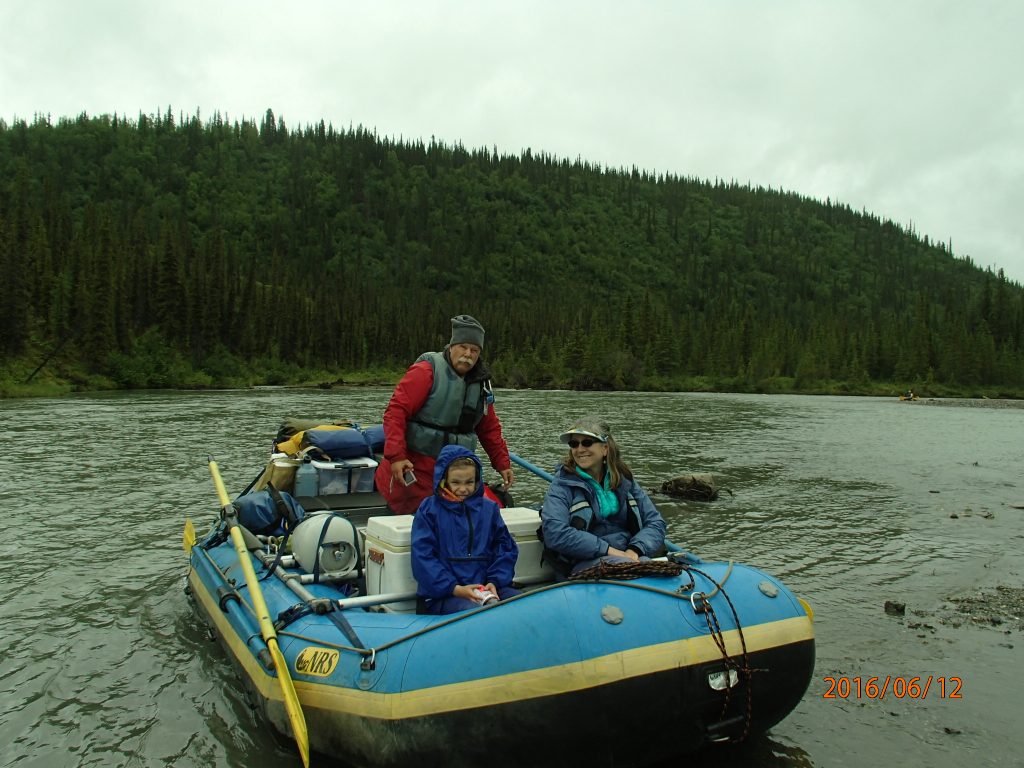
2016 – Vera, age 8, In Brad Snow’s raft leaving “Memory Moose Island.”
It was lightly raining, the grey rain clouds wavering over us. As we began to pack boats and inflate the inflatables, it became quite cold and foggy. When we were about to get on the river, rain was gently pelting down on us. Like any completely unsensible child, I decided to make things miserable at the beginning of this trip. I shoved a wide range of roadside flowers into my helmet, it was very tall and made me stand out among the crowd. As pretty as it was, it had its issues, as it attracted mosquitoes and annoying little buzzing bugs. As we got onto the river and began paddling for several hours, the flowers wilted and allowed water to drizzle down the back of my neck. My patience for the bright purples, yellows, and faint red flowers had dissipated, and I ripped it out right as I saw the triangular rock that sat river left.
I eagerly paddled onto the rocky shore, pulling my packraft onto the jabby rocks, dropped my paddle and lifejacket, and booked it for the bushes. I made it into the treeline and located my favorite climbing tree, one that always can bear my weight as I climb onto it and peer through the leaves at my friends getting their boats on land and taking gear out to set up for the night.

2021 – Vera paddling her packraft on Reindeer Hills stretch of Nenana RIver, age 13.
It was a rather foggy evening; the sun was peeking behind the green fluffy hills, the black spruce popping up like little deep red and green splinters. I stayed up in that tree for a while, watching my fellow paddlers move and bicker slowly like little colorful ants against the gravel bar. My dad was pulling out the tents and tarps from our packrafts, the canoes were taking out Le Pooper, the community feces bucket, and my father’s Dutch ovens for dinner. After a while, I got bored; I clumsily fell off the tree and into the stabby little bushes down below. I ran out to my father, listening to him talk with the zippers of the packraft, and picked up our tent. I ran towards another section of the island where I would find myself lost among the grasses and bushes if i went too far into the tree line. I found a nice flat, sandy spot and started to set up the tent, but I failed to get the tent poles to cooperate with me and left it for my dad to fuss. I changed out of my drysuit and into my warm white jacket and muddy little boots.

2016. Group on the Fairbanks Paddlers trip, together on “Memory Moose Island.”
I ran through the labyrinth area, lost as always. I came across a patch of yellow grass and noticed chunks of moose fur, some in massive piles and others hanging from the branches of bushes and small trees. Under a patch of dense brush, I found a moose jaw with loose teeth and hanging chunks of dried flesh. I kept digging around and found miscellaneous bones with little nibble marks. I scavenged around more and found the ear of some sort of canine animal. We later assumed it was either from a wolf or coyote. We never knew if the moose died due to a hunter or a group of wolves and then scrapped by a bear. It was there, and I saw it, and we kept the majority of the remnants of it. Parts not eaten by Raven. Some things were thrown away, some lost, and some still hang from the trees at home.As any chaotic little child would, I carried what I could and brought the bones to show the group. Our local biologist/paddlers were very happy to see my curiosity as to what bones were which and my questions about how old the moose was and whether it was male or female. I don’t happen to remember most of the answers they gave me, as it’s been several years since. Still, the joys of finding such special artifacts have permanently dubbed the name Memory Moose Island in my family and through most of our close friends who are also part of the Fairbanks Paddlers tribe.

2021. Vera, far right, sitting next to Inna Rivkin, trip leader. On “Memory Moose Island.”
Vera wrote this account of the beginnings of the Fairbanks Paddlers club as an assignment for her Native Literature English class at North Pole High School in February, 2025. The story was reviewed by Brad Snow. Cam Leonard shared the scanned PDF of original Fairbanks Whitewater Association charter that is linked in the story. Bruce Campbell shared the included photos.
